




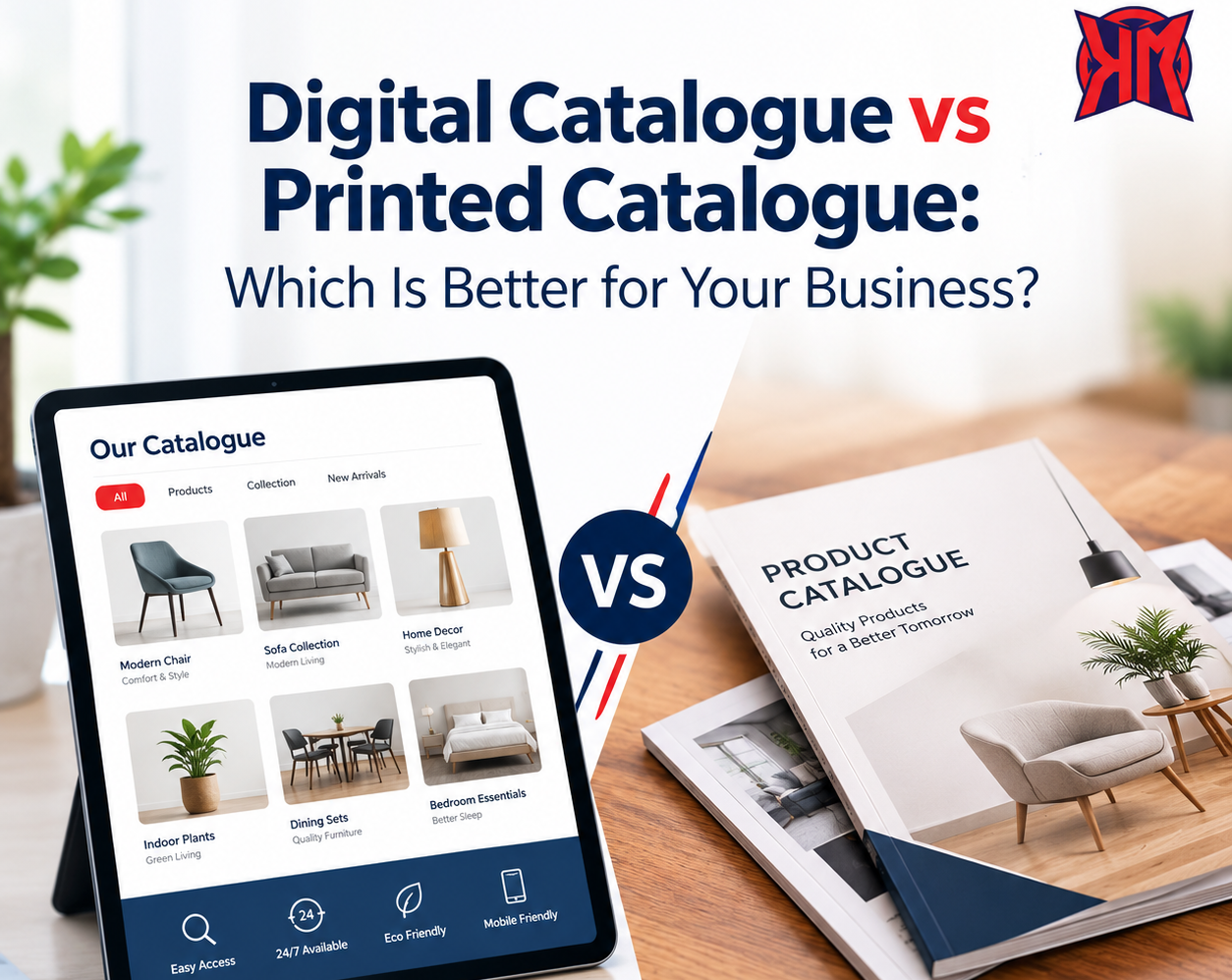
A catalogue is still one of the simplest ways for a business to present its products or services. The difference is that businesses no longer have to rely only on printed pages. Today, customers can browse a digital catalogue on their phone, laptop, or tablet, while printed catalogues continue to have a place in stores, meetings, exhibitions, and direct sales.
So, which option is better: a digital catalogue or a printed catalogue?
There is no single answer for every business. The right choice depends on your products, customers, sales process, budget, and how often your information changes. In some cases, using both can be the most practical approach.
For businesses considering professional catalogue designing, Kamal Media can help create a catalogue that presents products clearly while keeping the brand’s visual identity consistent across digital and print formats.
What Is a Digital Catalogue?
A digital catalogue is an online or electronic version of a product or service catalogue. It can be created as a PDF, interactive document, webpage, or another digital format.
Customers can open it from a phone or computer and browse products without needing a physical copy.
A digital product catalogue can include:
- Product images
- Product names and descriptions
- Prices and specifications
- Product categories
- Contact details
- Website links
- Social media links
- Enquiry or purchase buttons
- Videos or other interactive elements
For businesses that regularly update their products, prices, or offers, a digital catalogue can be particularly convenient.
What Is a Printed Catalogue?
A printed catalogue is a physical document containing information about a company’s products or services. It can range from a simple product booklet to a professionally designed, multi-page catalogue.
Printed catalogues are still useful in situations where customers prefer something they can physically hold and browse.
They are commonly used by:
- Manufacturers
- Wholesalers
- Retailers
- Distributors
- Furniture businesses
- Fashion brands
- Interior companies
- Industrial suppliers
- B2B companies
A well-designed printed catalogue can also strengthen a company’s physical brand presence. With the right layout, images, typography, and branding, a catalogue can become a useful sales tool rather than simply a product list.
Digital Catalogue vs Printed Catalogue: Key Differences
The biggest difference is how customers access and use the information.
| Factor | Digital Catalogue | Printed Catalogue |
| Accessibility | Available on phones and computers | Requires a physical copy |
| Distribution | Easy to share online | Distributed manually |
| Updating | Quick and flexible | Requires reprinting |
| Printing Cost | No printing required | Printing adds to cost |
| Reach | Can be shared worldwide | Usually limited by distribution |
| Customer Experience | Interactive and convenient | Physical and tangible |
| Storage | Stored digitally | Requires physical space |
| Product Changes | Easy to update | Changes may require a new print |
| Branding | Flexible digital presentation | Strong physical presentation |
| Best For | Online sales, enquiries and remote customers | Meetings, stores and exhibitions |
The better option depends on what your customers actually need.
Cost and Maintenance
One of the biggest advantages of a digital catalogue is that you don’t need to print hundreds or thousands of copies.
If your product range changes frequently, this can make a significant difference. You can update product information and distribute the new version without sending another batch to the printer.
Printed catalogues involve additional expenses such as:
- Paper
- Printing
- Binding
- Delivery
- Storage
- Reprinting
That doesn’t mean printed catalogues are always expensive or unsuitable. For businesses with stable product information and a defined local or B2B customer base, printed material can still provide good value.
When planning a business catalogue design, it is worth considering the long-term cost of maintaining the catalogue, not just the initial design and production cost.
Ease of Sharing and Distribution
This is where digital catalogues have a clear advantage.
A salesperson can share a catalogue through email, WhatsApp, a website, or social media within seconds. A potential customer can open it from almost anywhere.
For example, imagine a furniture supplier speaking with a customer in another city. Instead of arranging delivery of a physical catalogue, the salesperson can simply send the digital product catalogue and continue the conversation.
Printed catalogues work differently. They need to be physically delivered, handed over, or displayed somewhere.
For businesses that communicate with customers across multiple locations, digital distribution can make product information much easier to access.
Updating Products and Prices
Businesses rarely stay exactly the same. New products are introduced. Old products are discontinued. Prices change. Offers expire.
With a digital catalogue, these updates are generally easier to manage. You can create a revised version without throwing away your existing stock of catalogues. With a printed catalogue, an important change may mean another printing cycle.
This makes digital catalogues particularly useful for businesses with frequently changing inventories.
Customer Experience and Branding
A catalogue isn’t only about listing products. It also represents your brand. A professionally designed catalogue can make your business look more organised and credible.
Digital catalogues provide opportunities to add elements such as clickable links, product pages, videos, enquiry buttons, and other interactive features. Printed catalogues offer a different experience. Customers can physically hold them, flip through pages, mark products, and keep them for later reference. For some businesses, that physical experience still matters.
This is why catalogue design should consider more than just fitting products onto pages. The layout, imagery, typography, colours, spacing, and brand elements all contribute to how customers perceive the business.
When Should a Business Choose a Digital Catalogue?
A digital catalogue may be a better choice if your business:
- Sells to customers in different cities or countries
- Receives enquiries through WhatsApp or email
- Frequently changes products or prices
- Has a large product range
- Wants to reduce printing costs
- Depends heavily on online marketing
- Wants customers to access products from their phones
- Needs to share product information quickly
For online-first businesses, a digital catalogue design can fit naturally into the overall customer journey.
Kamal Media can also help businesses present their products through professionally structured catalogue designs that are easy to browse and aligned with their existing branding.
When Is a Printed Catalogue Still Useful?
Printed catalogues haven’t disappeared. They can still be valuable in situations where face-to-face interaction is important.
A printed catalogue can work well for:
- Trade shows
- Exhibitions
- Retail stores
- Sales meetings
- Dealer networks
- Client presentations
- Product demonstrations
- Local distribution
For example, an industrial supplier meeting a potential dealer may find it useful to hand over a physical catalogue containing product specifications and images.
The customer can keep it and refer to it later.
In these situations, a printed catalogue can work as a physical reference while also reinforcing the company’s professional image.
Can Businesses Use Both?
Yes, and this can actually be the most practical solution. A business doesn’t necessarily have to choose between digital and print. For example, a company could use a printed catalogue during exhibitions and sales meetings while maintaining a digital version for customers who enquire through its website or social media. The two formats can support each other.
A printed catalogue could also include a QR code that takes customers to the company’s website or online catalogue. This creates a simple connection between offline and online marketing. For businesses working with Kamal Media, combining digital and print catalogue formats can also help maintain consistent branding across different customer touchpoints.
Digital Catalogue vs Printed Catalogue: Which One Should You Choose?
Before deciding, ask yourself a few simple questions:
How often do your products or prices change?
If the answer is frequently, digital may be more practical.
Where are your customers located?
If you sell across different cities, states, or countries, digital distribution can make things much easier.
How do customers usually contact you?
If most enquiries come through WhatsApp, email, or your website, a digital catalogue fits naturally into that process.
Do you regularly attend exhibitions or sales meetings?
If yes, printed catalogues may still be useful.
What is your budget?
Consider not just the initial design cost, but also printing, distribution, storage, and future updates.
Thinking through these questions can help you decide whether your business needs a digital catalogue, a printed catalogue, or both.
The Right Catalogue Depends on Your Business Needs
A digital catalogue is convenient, easy to distribute, and simple to update. A printed catalogue provides a physical experience and can work particularly well for meetings, exhibitions, stores, and traditional sales environments.
For many modern businesses, the smartest approach isn’t choosing one and ignoring the other. A combination of digital catalogue design and printed catalogue design can give customers more ways to explore your products while keeping your brand consistent across different channels.
Kamal Media understands that a catalogue should do more than display products. Good catalogue designing should make information easy to find, products easy to understand, and the overall brand easy to remember.
The goal isn’t simply to create a catalogue. It is to make your products easier to understand, easier to explore, and easier for customers to enquire about or buy.
Frequently Asked Questions
Is a digital catalogue better than a printed catalogue?
It depends on the business. Digital catalogues are easier to share and update, while printed catalogues can be more useful for physical meetings, exhibitions, stores, and direct sales.
What is a digital product catalogue?
A digital product catalogue is an electronic presentation of a company’s products, services, descriptions, images, specifications, prices, and other relevant information.
Can a digital catalogue be shared on WhatsApp?
Yes. Depending on its format, a digital catalogue can be shared through WhatsApp, email, websites, social media, and other digital channels.
Is a printed catalogue still useful in 2026?
Yes. Printed catalogues can still be useful for exhibitions, sales meetings, retail environments, dealer networks, and businesses where customers prefer physical product information.
Can I use both digital and printed catalogues?
Yes. Using both formats can help businesses reach customers through online channels while maintaining a physical sales and marketing presence.
How often should a product catalogue be updated?
There is no fixed schedule. It should be updated whenever important information changes, such as product availability, pricing, specifications, offers, or contact details.
What should a business catalogue include?
A catalogue can include product images, descriptions, specifications, prices, categories, company information, contact details, website links, and calls to action.
Why is catalogue design important?
Good catalogue design helps customers understand products quickly and makes the business look organised and professional. Clear layouts, quality images, readable text, and consistent branding can improve the overall experience.