

Posting consistently is not the same as having a social media strategy. A business can publish five times a week, create attractive Reels, follow trends and gain followers—yet still have no clear idea whether social media is helping the business grow. That is where many brands get stuck.
They focus on what to post before deciding why they are posting it.
A better approach starts somewhere else: with the business objective.
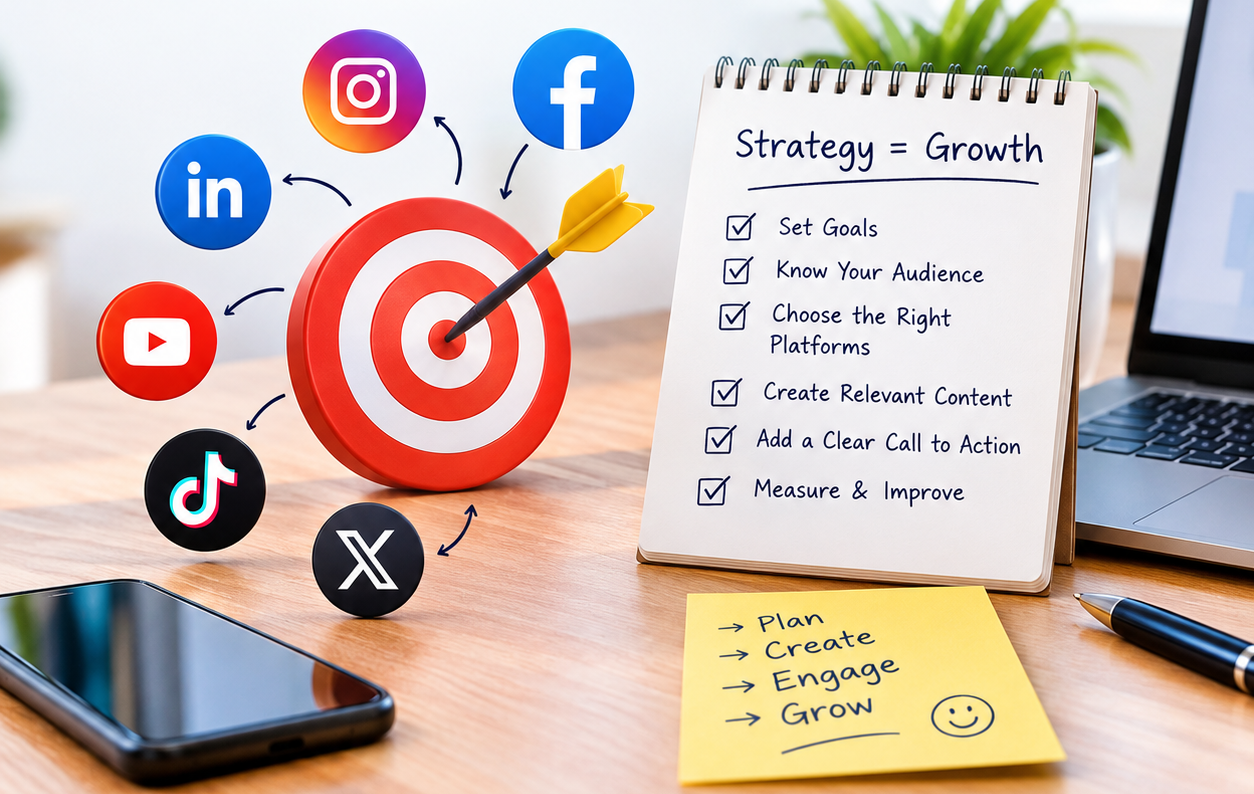
A strong social media strategy connects the right audience, platforms, content and calls to action with a measurable business purpose. Current 2026 guidance from major social media platforms and strategy publishers continues to emphasize this connection between goals, audience, content and measurement.
For businesses working with a Digital Marketing Agency in Punjab, this approach can turn social media from a daily posting task into a more connected part of the overall marketing journey.
Social Media Strategy vs. Simply Posting Content
Imagine two businesses.
Business A publishes whatever seems interesting that day.
Monday: motivational quote.
Wednesday: product graphic.
Friday: trending Reel.
Business B has decided that social media should build awareness, answer customer questions, demonstrate expertise and move interested visitors towards its website.
Both businesses may be posting regularly.
Only one has a clear strategy.
A social media strategy defines:
- What the business wants to achieve
- Who it wants to reach
- Which platforms deserve attention
- What topics the brand should own
- What content formats make sense
- What action people should take
- Which metrics indicate progress
In other words:
A content calendar tells you when to post. A strategy tells you why the post exists.
That distinction should shape everything that follows.
Start With the Business, Not the Platform
One of the easiest mistakes is beginning with:
“Should we use Instagram or LinkedIn?”
That question comes too early.
First ask:
“What does the business need from social media?”
Possible objectives include:
- Building brand awareness
- Generating qualified leads
- Increasing website traffic
- Supporting sales
- Promoting products
- Building customer relationships
- Establishing industry authority
- Supporting customer retention
The objective should also be measurable.
For example:
Too vague:
“We want better social media.”
More useful:
“We want social media to generate qualified enquiries from our target market.”
Too vague:
“We want more followers.”
More useful:
“We want to build a relevant audience that regularly engages with our educational content.”
Current guidance recommends connecting social goals directly to wider business objectives and mapping them to appropriate KPIs rather than relying mainly on follower counts or likes.
For businesses combining organic social activity with paid campaigns, a Performance Marketing Agency can also help connect campaign activity with measurable acquisition goals.
Know Who You Are Actually Talking To
A social media strategy becomes much stronger when the audience is specific.
“People who use Instagram” is not an audience.
Neither is “everyone who needs our service.”
Ask more useful questions:
- Who is the actual buyer?
- What problem are they trying to solve?
- What questions do they ask before purchasing?
- What prevents them from taking action?
- What information builds their trust?
- Which platforms do they actually use?
- Are they discovering, comparing or ready to buy?
For example, a B2B company may be speaking to business owners and procurement managers, while a local service business may need to reach customers within a particular city.
Audience research should come from more than assumptions. Social analytics, website behaviour, customer conversations, search queries and sales feedback can all reveal what matters to the target audience. Current audience research guidance similarly recommends using real behavioural insights to refine targeting and content.
A simple test
Don’t ask only:
“Who follows our page?”
Ask:
“Who do we want to take the next step?”
That answer is much more useful for strategy.
Choose Platforms Based on Purpose
There is no prize for maintaining the largest number of social media accounts.
If a business has limited time and resources, three poorly managed platforms can be less useful than one or two platforms managed with consistency and purpose.
The choice should come from:
Audience + Objective + Content Capability
For example:
- Instagram: visual storytelling, short-form video, products and lifestyle-led communication
- LinkedIn: B2B communication, professional audiences and industry expertise
- YouTube: demonstrations, education and long-form video
- Facebook: communities, local audiences and certain advertising objectives
These are starting points, not fixed rules. Platform behaviour changes, and businesses should use their own audience data to validate where their attention belongs.
The content should also feel native to the platform rather than simply being copied everywhere.
For businesses that need strategic planning, content management and campaign support, a Social Media Marketing Agency can help turn platform decisions into an organized workflow.
Build a Content System, Not a Random Collection of Posts
Once the objective and audience are clear, the next question is:
What should the brand consistently talk about?
This is where content pillars become useful.
A business might build its social media around four or five core areas:
1. Education
Teach the audience something useful.
2. Problem Solving
Address questions, objections and common challenges.
3. Proof
Show experience through projects, demonstrations, reviews or case studies.
4. Industry Insight
Share useful observations about the market or industry.
5. Brand
Show the people, process, values and thinking behind the business.
The important part is that each pillar should have a role.
For example:
Education creates understanding.
Problem-solving creates relevance.
Proof supports trust.
Brand content builds familiarity.
Promotional content encourages action.
This makes content easier to plan without making it repetitive.
Current content-planning guidance also treats planning as more than scheduling—it includes ideation, creation, workflow and measurement.
Give Every Post a Job
Before publishing a piece of content, ask:
What is this post supposed to do?
Maybe it should:
- Explain something
- Start a conversation
- Build trust
- Generate a website visit
- Encourage an enquiry
- Demonstrate expertise
- Introduce a product
- Strengthen brand recognition
A useful structure is:
Problem → Insight → Solution → Next Step
For example:
Problem: A company receives website visitors but very few enquiries.
Insight: More traffic will not automatically solve a weak conversion journey.
Solution: Improve the page message, proof, navigation and CTA.
Next Step: Encourage the visitor to explore the relevant service or contact the business.
This is far more purposeful than simply writing:
“Want more customers? Contact us today!”
The audience should receive something useful before being asked to take action.
Make the Brand Recognizable Before It Becomes Memorable
Consistency matters.
A social profile should feel like it belongs to the same business from one post to another.
That includes:
- Visual identity
- Typography
- Colours
- Photography
- Graphic style
- Video style
- Writing tone
- Messaging
A can help establish the wider brand identity, while a Logo Design Agency can develop the visual mark used across digital channels.
But a logo alone does not create recognition.
A strong brand can often be recognized through its voice, visual language and way of communicating even when the logo is not immediately visible.
Connect Social Media With the Website
This is where many social media strategies lose momentum.
Someone discovers a business through a post.
They become interested.
They click the profile.
Then what?
If the website does not clearly explain the service, answer questions or provide an easy next step, the journey can stop there.
Your website should support social traffic with:
- Relevant landing pages
- Clear service information
- Strong calls to action
- Simple enquiry forms
- Mobile-friendly pages
- Consistent branding
- Useful supporting content
A professional Web Design Agency can help improve the user experience, while a Web Development Company can support the technical side of forms, integrations, tracking and website functionality.
Think of the journey as:
Social Discovery → Website → Information → Trust → Action
Social media does not always need to make the sale.
Sometimes its most important job is getting the right person to the right next step.
Use Visual Content to Explain, Not Just Decorate
Social media is highly visual, but attractive design alone does not create effective communication.
Depending on the business, useful visual assets can include:
- Carousels
- Infographics
- Product graphics
- Short videos
- Demonstrations
- Brochures
- Service explainers
- Catalogues
For businesses with multiple products or technical information, professional Catalogue Designing Company support can help organize complex information into more usable visual material.
The principle is simple:
Design should make the message clearer.
If people remember the graphic but cannot explain what the business actually offers, the design has not completed its job.
Build a Content Calendar That Leaves Room for Reality
A good content calendar creates structure without making the brand robotic.
It can include:
| Element | Purpose |
| Topic | What are we talking about? |
| Platform | Where will it be published? |
| Format | Reel, carousel, image, video, etc. |
| Objective | What should it achieve? |
| CTA | What should the audience do? |
| Date | When will it go live? |
| Result | What happened after publishing? |
For example:
Monday: Educational carousel
Wednesday: Short-form video
Friday: Case study
Saturday: Brand/community content
But leave space for real-time opportunities.
A good strategy can respond to:
- Industry developments
- Customer questions
- Local events
- Product launches
- Relevant trends
- Important announcements
Planning should create consistency—not prevent the brand from being relevant.
Measure Business Value, Not Just Social Activity
This is one of the most important parts of the entire strategy.
A business can receive:
- Thousands of views
- Hundreds of likes
- Growing followers
and still generate very little business value.
That does not mean these metrics are useless. It means they need context.
The right KPI depends on the objective.
| Objective | Useful Metrics |
| Awareness | Reach, impressions, audience growth |
| Engagement | Shares, saves, comments, engagement rate |
| Traffic | Clicks, referral traffic, landing-page visits |
| Leads | Enquiries, form submissions, qualified leads |
| Sales | Conversions, revenue, ROAS where applicable |
| Customer service | Response time, resolution rate |
Current measurement guidance similarly recommends choosing metrics according to business objectives and connecting social activity with wider outcomes.
A useful question is not:
“Which post went viral?”
It is:
“Which activity created meaningful movement toward our business goal?”
That distinction can completely change how a company evaluates social media.
Local Social Media Strategy Needs Local Relevance
A local business should not simply add a city name to every caption.
Location should have a genuine role.
That could mean:
- Local customer stories
- Area-specific services
- Regional offers
- Community participation
- Local events
- Location-based FAQs
- Customer reviews
- City-specific landing pages
For businesses targeting different areas, Kamal Media has location-focused services including Digital Marketing Agency in Ludhiana, Digital Marketing Agency in Chandigarh, Digital Marketing Agency in Mohali and Digital Marketing Agency in Panchkula.
For wider regional targeting, the Digital Marketing Agency in Haryana service page provides another relevant pathway.
The principle remains:
Use location because it matters to the customer, not simply because it is a keyword.
International Markets Need More Than a Translated Caption
The same social media strategy does not necessarily work identically across different countries.
A business targeting Surrey may communicate differently from one targeting California or Australia.
Market differences can involve:
- Language
- Cultural expectations
- Buying behaviour
- Competition
- Time zones
- Content preferences
- Local proof
- Customer expectations
Kamal Media also supports location-focused digital marketing through Digital Marketing Agency in Surrey, Digital Marketing Agency in Brampton,Digital Marketing Agency in California and Digital Marketing Agency in Australia.
The brand can remain consistent while the examples, language, offers and communication style are adapted to the market.
Think Beyond the Post: Build a Customer Journey
Not every person who sees your content is ready to buy.
A stronger strategy recognizes different stages.
Discovery
The audience is learning about a problem.
Content can include:
- Educational posts
- Short videos
- Industry insights
- Problem-awareness content
Consideration
The audience is researching possible solutions.
Content can include:
- Comparisons
- Guides
- Case studies
- Demonstrations
- FAQs
- Testimonials
Decision
The audience is closer to taking action.
Content can include:
- Service details
- Offers
- Proof
- Clear CTAs
- Enquiry options
Retention
The customer already knows the brand.
Content can include:
- Support
- Product education
- Updates
- Community content
- Customer-focused information
This is why a social media strategy should not be built around one content type.
Different content should move people through different stages.
The Social Media Mistakes That Quietly Waste Time
Posting Without a Goal
If the team cannot explain why a post exists, the content strategy needs more clarity.
Chasing Every Trend
A trend is useful only when it fits the brand, audience and objective.
Copying Competitors
Competitor research can reveal opportunities, but copying their content rarely creates differentiation.
Measuring Only Followers
Audience size matters, but relevance and business outcomes matter too.
Treating Every Platform the Same
A strong idea can be repurposed, but its format and presentation should suit the platform.
Ignoring Comments and Messages
Conversations are valuable sources of customer insight.
Forgetting the Website
Social traffic has limited value if the next step is confusing.
Changing Direction Too Quickly
One underperforming post is not enough evidence to rebuild the entire strategy.
A Practical 10-Point Social Media Strategy Framework
Before launching your next campaign, write down these ten points:
- Business Objective
What result does the business actually want? - Target Audience
Who matters most? - Customer Problem
What are they trying to solve? - Platform Selection
Where can they realistically be reached? - Content Pillars
What subjects should the brand consistently own? - Content Formats
Which formats communicate those subjects best? - CTA
What should the audience do next? - Website Journey
Where should interested users go? - KPIs
Which numbers indicate progress? - Review Cycle
What will be changed based on the results?
This framework can also work alongside an SEO Agency strategy, because social media and search can support the same broader customer journey rather than functioning as completely separate marketing channels.
When Should You Consider Professional Social Media Support?
Not every business needs an agency from day one.
But professional support can become valuable when:
- Content has become inconsistent
- The team lacks a clear strategy
- Campaigns are difficult to measure
- Paid and organic marketing are disconnected
- The business is entering a new market
- Branding is inconsistent
- The website and social content do not work together
- Internal teams are spending too much time creating content without clear outcomes
The right question is not:
“Can someone create posts for us?”
It is:
“Can our marketing activity become more strategic, measurable and connected?”
For a business operating in Patiala and looking to connect social media with wider digital marketing services, the Digital Marketing Agency in Patiala service pathway can provide a starting point.
Frequently Asked Questions About Social Media Strategy
What is a social media strategy?
A social media strategy is a structured plan that connects business objectives with audience research, platform selection, content, calls to action and performance measurement.
How do I create a social media strategy?
Start with the business objective, define the target audience, select relevant platforms, create content pillars, plan content, connect social activity with your website and establish measurable KPIs.
What is the difference between a strategy and a content calendar?
A strategy explains the direction and purpose. A content calendar organizes the individual posts used to execute that strategy.
How many social media platforms should a business use?
There is no fixed number. Businesses should prioritize platforms where their target audience is relevant and where they can consistently produce useful content.
What are content pillars?
Content pillars are recurring themes that organize social media content and help a brand maintain consistency without repeatedly publishing the same type of post.
What metrics should I track?
Track metrics according to the objective. Awareness may require reach and impressions, while lead-generation campaigns may need website visits, enquiries, qualified leads and conversions.
Should every post promote a product?
No. Educational, helpful, entertaining and trust-building content can be equally important. Promotional content works better when it has a clear role within the wider strategy.
Is social media useful for local businesses?
Yes, when local content is connected to genuine customer needs. Location-specific services, reviews, community content and regional information can all contribute to a local strategy.
How often should a business post?
There is no universal number. The best schedule is one that the business can maintain consistently while continuing to produce valuable content.
Can social media work with SEO?
Yes. Social media and SEO can support the same broader customer journey by increasing brand visibility, distributing useful content and helping audiences discover relevant website resources. They should still be measured according to their individual roles.
Conclusion: Give Every Social Media Action a Reason
A successful social media strategy is not about filling a calendar.
It is about creating a system where the business goal influences the audience, the audience influences the content, the content influences the next action and the results influence what happens next.
That is what turns social media from a publishing routine into a marketing strategy.
The strongest brands are not necessarily the ones posting the most.
They are the ones that understand why they are showing up, who they are speaking to and what they want that audience to do next.
When social media is connected with branding, website development, SEO and performance marketing, it can become part of a much larger and more consistent digital customer journey.
Businesses looking to build that connected approach can explore Kamal Media and its digital marketing services to develop a strategy around their specific audience, market and business objectives.