
Getting people to see your Facebook or Instagram ad is relatively easy. Getting the right people to enquire, share their details and eventually become customers is where the real work begins.
That’s why successful advertising is about more than boosting posts or creating attractive graphics. A proper performance marketing strategy connects the ad, audience, offer, landing page, follow-up process and conversion tracking.
For businesses in India, Facebook and Instagram can be useful channels for generating leads because they allow businesses to reach specific audiences with different messages and creative formats. But the goal shouldn’t simply be to collect as many leads as possible.
The better question is:
How can you generate leads that are actually relevant to your business?
This guide explains how to build a Facebook and Instagram lead-generation campaign, what to promote, how to improve lead quality and where Meta Ads and Google Ads fit into the overall strategy.
What Is Performance Marketing?
Performance marketing is a results-focused approach to digital advertising where campaigns are measured against specific business actions, such as leads, enquiries, bookings, purchases or qualified prospects.
Instead of judging a campaign only by impressions or likes, businesses can look at metrics such as:
- Leads generated
- Cost per lead
- Qualified leads
- Conversion rate
- Cost per acquisition
- Sales generated
- Return on advertising spend
- Revenue from advertising
This difference matters.
A campaign can generate hundreds of enquiries and still perform poorly if most of those enquiries aren’t relevant.
On the other hand, a campaign with fewer leads can be much more valuable if those leads are genuinely interested and more likely to become customers.
For businesses that want a measurable advertising strategy, performance marketing services can bring paid campaigns, conversion tracking and optimisation together instead of treating advertising as a one-off activity.
Can Facebook and Instagram Ads Generate Leads in India?
Yes. Facebook and Instagram can be used to generate leads for many types of businesses, including local businesses, service providers, education brands, real estate businesses, e-commerce companies, professionals, creators and growing brands.
But simply running an advertisement doesn’t guarantee good leads.
Your campaign needs four things to work together:
Right audience + relevant offer + convincing creative + simple conversion process
If even one of these is weak, performance can suffer.
For example, an excellent ad shown to the wrong audience won’t generate useful enquiries. Likewise, the right audience may click an ad but leave if the offer isn’t clear.
That’s why lead generation should be treated as a complete funnel rather than a single advertisement.
Step 1: Decide What You Actually Want From the Campaign
Before opening Ads Manager, decide what the campaign needs to achieve.
Are you looking for:
- Phone enquiries?
- WhatsApp conversations?
- Website enquiries?
- Consultation requests?
- Appointment bookings?
- Course enquiries?
- Product purchases?
- Quote requests?
- Qualified business leads?
This decision affects your campaign structure, creative, landing page and measurement.
A common mistake is starting with “I want more leads” without defining what a useful lead actually means.
For a service business, a qualified lead might be someone who needs the service, fits the target location and is genuinely considering purchasing.
That definition gives your campaign something meaningful to optimise towards.
Step 2: Understand Your Indian Audience
India isn’t one single audience.
Customer behaviour can vary significantly depending on location, language, age, income level, profession, buying intent and the type of product or service being promoted.
A campaign targeting a local business in Patiala shouldn’t necessarily use the same audience strategy as a brand selling across India.
Start by identifying:
Location
Decide whether you want to target:
- A specific city
- Several cities
- A state
- Multiple states
- The entire country
- Indian audiences in another country
For a local business, tighter geographic targeting can make more sense than spending money reaching people who cannot realistically become customers.
Customer profile
Think about who is most likely to buy.
For example:
A coaching business: students, parents or working professionals depending on the course.
A B2B service: business owners, decision-makers or specific professional groups.
A lifestyle brand: consumers with particular interests, behaviours or purchasing needs.
The more clearly you understand the customer, the easier it becomes to create an offer that speaks to them.
Step 3: Create an Offer People Have a Reason to Respond To
An advertisement needs to give people a reason to take action.
“Contact us today” can work, but it isn’t always enough.
Depending on the business, your offer could be:
- Request a consultation
- Get a personalised quote
- Book an appointment
- Enquire about a service
- Download useful information
- Schedule a call
- Get course details
- Request a product demonstration
The offer should match the customer’s stage in the buying journey.
Someone discovering your brand for the first time may not be ready to make a purchase immediately. A lower-friction action can sometimes make more sense.
Step 4: Build Facebook and Instagram Ads Around the Customer’s Problem
The best ad isn’t necessarily the one with the fanciest design.
It is the one that makes the right person stop and think:
“This is exactly what I need.”
A strong creative usually communicates three things quickly:
- The problem
- The solution
- The next action
For example, instead of writing a vague message about “high-quality digital services,” a campaign could focus on a specific problem such as getting website visitors but not enough enquiries.
That immediately gives the audience context.
Use different creative formats
Don’t rely on one image for an entire campaign.
Depending on the offer, test:
- Short videos
- Reels
- Static graphics
- Carousel ads
- Customer-focused visuals
- Product demonstrations
- Educational creatives
- Problem-and-solution formats
Different people respond to different creative styles, so testing gives you useful performance data.
Step 5: Write Ad Copy That Matches Search and Social Intent
People don’t behave the same way on Google and social media.
Someone searching Google for “performance marketing agency in Patiala” may already have strong commercial intent.
Someone scrolling Instagram may not have been actively looking for the service at all.
That means social ads often need to create interest before asking for the conversion.
A simple structure is:
Problem → Benefit → Proof or reason to believe → CTA
Keep the message focused.
Don’t try to explain every feature of your business inside one advertisement. Give people enough information to understand the value and take the next step.
Step 6: Choose Between Instant Lead Forms and Landing Pages
There are two common approaches to capturing leads.
Instant lead forms
The user can submit their information without leaving the platform.
This can reduce friction and make it easier for someone to respond to an ad.
However, fewer fields can also mean less information about the prospect.
Website landing pages
The user clicks through to a dedicated page where they can learn more before submitting an enquiry.
This approach can be useful when your product or service needs explanation, comparison or trust-building.
The landing page should match the advertisement.
If the ad promises one thing and the page talks about something else, the visitor has a reason to leave.
Step 7: Don’t Ask for Too Much Information
A lead form isn’t a questionnaire.
If you ask for too many details, people may simply abandon it.
At the same time, asking one or two relevant qualifying questions can help filter out poor-fit enquiries.
For example, a business might ask:
- What service are you interested in?
- Which location are you based in?
- What type of business do you operate?
- When are you planning to start?
The right questions depend on the business.
The goal is to collect useful information without creating unnecessary friction.
Google’s current lead-generation guidance similarly recommends relevant questions and qualifying responses when they can help improve lead quality.
Step 8: Make Your Landing Page Do Its Job
If you’re sending Facebook or Instagram traffic to a website, don’t send everyone to a random page and hope for the best.
Create a page that supports the campaign.
A strong landing page should make it clear:
- What you’re offering
- Who it’s for
- Why it matters
- What the visitor should do next
- How they can contact you
- What information they need to provide
The page should also work properly on mobile devices.
A slow, confusing or cluttered page can waste the money you’ve already spent getting the visitor there.
If your website needs improvement, web design services can also play an important role in improving the experience between the ad click and conversion.
Step 9: Follow Up Quickly
Generating a lead is only half the job.
What happens after someone submits a form can have a major effect on the final outcome.
If a genuine prospect submits an enquiry and nobody follows up properly, the campaign may appear to have poor performance even though the advertising worked.
Create a clear process for:
Lead received → Lead contacted → Lead qualified → Follow-up → Sales conversation → Customer
This is where performance marketing becomes more than advertising.
You’re measuring the complete journey rather than stopping at the form submission.
Step 10: Track Qualified Leads, Not Just Lead Volume
This is one of the most important parts of lead generation.
Imagine two campaigns:
| Campaign | Leads | Qualified Leads |
| Campaign A | More | Fewer |
| Campaign B | Fewer | More |
If Campaign B produces more genuine business opportunities, it may be the stronger campaign even though it generated fewer total leads. Google Ads now provides dedicated ways to distinguish qualified leads and converted leads, helping advertisers connect advertising activity with deeper stages of the sales funnel.
The same principle should guide your wider performance marketing strategy. Don’t optimise blindly for volume. Optimise for business value.
Facebook and Instagram Ads vs Google Ads: Which Is Better for Leads?
There isn’t one universal winner.
The two platforms can capture different types of demand.
| Channel | Typical strength |
| Facebook & Instagram Ads | Creating demand, reaching defined audiences and generating interest |
| Google Ads | Capturing people actively searching for products or services |
| Meta Ads + Google Ads | Combining demand generation with existing search intent |
Someone searching Google for a service is already expressing intent.
Someone watching a Reel may not be actively searching, but the right creative can introduce them to a solution they hadn’t considered.
That is why businesses with enough budget and a suitable offer can use both channels as part of a wider performance marketing strategy.
Google also supports lead forms within eligible Search and Performance Max campaigns, allowing prospects to submit information directly through the ad experience.
What About Google Ads for Lead Generation?
Google Ads can complement Facebook and Instagram campaigns by capturing users who are actively searching for a solution.
For example, someone searching for:
- Digital marketing agency
- Performance marketing agency
- SEO services
- Website design company
- Social media marketing agency
is showing a different type of intent from someone simply scrolling through social media.
Google recommends measuring conversions and using meaningful conversion goals rather than relying only on clicks or impressions.
This becomes particularly important for businesses with longer sales cycles.
A lead that eventually becomes a customer is more valuable than a form submission that never gets qualified.
How to Reduce Low-Quality Leads From Meta Ads
Getting irrelevant enquiries is one of the most common frustrations with lead-generation campaigns.
The solution isn’t always to stop advertising.
Instead, look at where the mismatch is happening.
Review your audience
Are you reaching people who can actually buy your product or service?
Make the ad more specific
Vague messaging can attract a broad audience. Specific messaging can help people self-select.
Add qualifying questions
Ask for information that helps you understand whether the person is a genuine prospect.
Review the offer
An overly broad or attractive offer may encourage people who aren’t serious to submit a form.
Improve follow-up and lead scoring
Not every lead should receive the same sales response.
The goal is to identify which prospects are worth prioritising.
How Often Should You Optimise Facebook and Instagram Ads?
Performance marketing isn’t a “set it and forget it” process.
But that doesn’t mean you should change everything every day.
Look for patterns in:
- Lead quality
- Cost per lead
- Conversion rate
- Creative performance
- Audience response
- Landing page conversions
- Qualified lead rate
- Sales outcomes
Then make changes based on evidence.
Change one important variable at a time where practical so you can understand what actually influenced the result.
Common Facebook and Instagram Advertising Mistakes
Boosting every post
Boosting a post isn’t the same as building a complete lead-generation strategy.
Targeting everyone
A large audience isn’t automatically a valuable audience.
Using the same creative for months
People can become less responsive to repetitive advertising.
Measuring only clicks
Clicks don’t pay the bills. Business outcomes do.
Sending traffic to an unrelated page
The ad and landing experience should make sense together.
Ignoring lead follow-up
Even a strong campaign can lose potential customers if enquiries aren’t handled properly.
Optimising only for cheap leads
A low-cost lead isn’t necessarily a good lead.
How Kamal Media Approaches Performance Marketing
For businesses looking for a structured approach, Kamal Media can combine paid advertising with broader digital marketing activities instead of treating each channel separately.
Its performance marketing services can support campaigns where the focus is on measurable outcomes, while social media marketing services can support the wider social presence and content strategy.
For businesses in Punjab, working with a digital marketing agency in Punjab can also make sense when campaigns need to account for local audiences, regional markets and broader Indian targeting.
The important point is that advertising should fit the business objective.
A campaign for a local Patiala service provider won’t necessarily need the same strategy as a campaign targeting customers across India.
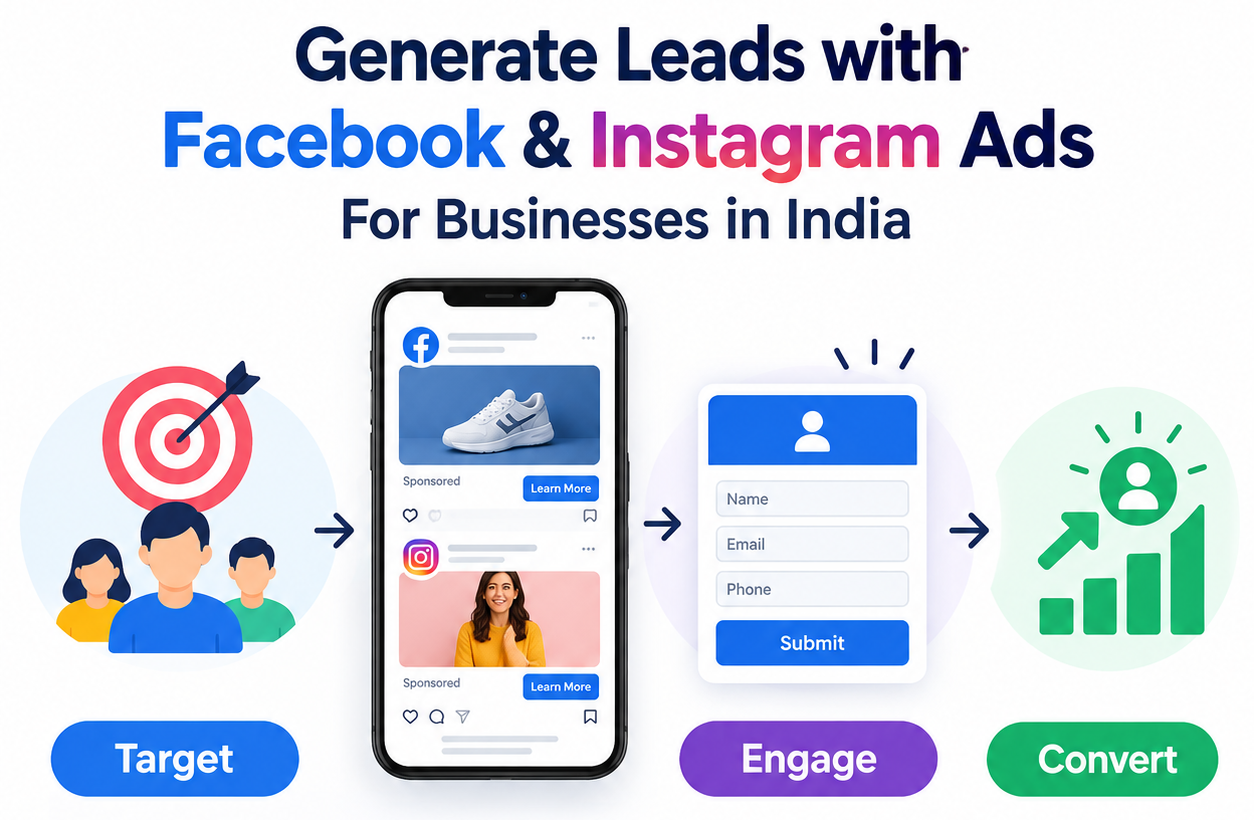
A Simple Facebook and Instagram Lead Generation Funnel
A practical funnel can look like this:
Audience
↓
Facebook / Instagram Ad
↓
Relevant Offer
↓
Lead Form or Landing Page
↓
Lead Qualification
↓
Sales Follow-Up
↓
Customer
↓
Repeat Customer / Referral
Each stage matters.
If the ad gets attention but the landing page doesn’t convert, there’s a problem.
If the form generates leads but sales teams can’t qualify them, there’s another problem.
If qualified leads aren’t followed up, advertising spend can be wasted.
That’s why performance marketing should be measured across the complete funnel.
Build a Better Lead Generation Strategy
Generating leads from Facebook and Instagram Ads in India isn’t simply about creating an advertisement and waiting for enquiries.
The strongest campaigns connect the audience, offer, creative, conversion experience, follow-up and measurement.
Use Meta Ads to reach and engage the right people. Use landing pages or lead forms to capture genuine interest. Track what happens after the form is submitted. And where appropriate, combine social advertising with Google Ads to capture people who are already searching for a solution.
Most importantly, don’t judge success by lead volume alone.
The real question is:
How many of those leads can become valuable customers?
That is where performance marketing becomes a growth strategy rather than just paid advertising.
If your business is based in Patiala, Punjab, or serves customers across India, start by defining the customer you actually want, the action you want them to take and the business outcome you’re trying to achieve. Then build the campaign around those goals.